Christ the new Adam, in the very revelation of the mystery of the Father and of his love, fully reveals man to himself and brings to light his most high calling (Gaudium et Spes, n.22).
Sunday, 4 July 2010
At the seaside ...
Sunday, 16 May 2010
The elephants in the park
Monday, 8 February 2010
Bradwell-on-Sea
Friday, 22 January 2010
John Henry Newman: phenomenologist or transcendental Thomist?
It is the characteristic of our minds to be ever engaged in passing judgement on the things that come before us. No sooner do we apprehend than we judge: we allow nothing to stand by itself: we compare, contrast, abstract, generalize, connect, adjust, classify: and we view all our knowledge in the associations with which these processes have invested it.I will definitely show my age - or at least the era of my philosophical education - when I say that the two immediate thougths that came into my mind on reading this first section of Chapter I of Newman's An Essay on the Development of Christian Doctrine were the following:
Of the judgements thus made, ... some are mere opinions which come and go.... Others are firmly fixed in our minds.... Many of them attach to one and the same object, which is variously viewed ..... some are only not inconsistent with each other, in that they have a common origin: some, as being actually incompatible with each other, are, one or other, falsely associated in our minds with their object, and in any case they may be nothing more than ideas, which we mistake for things.
Was Newman, without realising it, following the same sort of school of thought as would later be taken by Husserl and the phenomenological school? "Idea", the concern for "things", the delineation of the content of an idea apprehended? And, indeed, the very style of analytical writing?
Or was he a transcendental Thomist before such a thing was even thought of? Doesn't the first paragraph put one in mind of Lonergan? "Apprehend", "abstract" "judgement"?
You do not have to read very far into the Essay on Development to come across the much abused quotation:
In a higher world it is otherwise, but here below to live is to change, and to be perfect is to have changed often.And recognising the context, is, of course, the key to understanding what Newman intended in this sentence. First of all, Newman has in the preceding pages given a phenomenological account of the way in which an idea can develop in human society as it encounters different ideas and situations and so shows itself in different aspects. And then the sentence immediately preceding the oft quoted one is:
It [ie the idea] changes with them [ie the surrounding circumstances, the history of its encounter with other ideas, etc] in order to remain the same.In the preceding pages, Newman has clearly expressed an idea of development in ideas as
... the germination and maturation of some truth or apparent truth on a large mental field. On the other hand this process will not be a development, unless the assemblage of aspects, which constitute its ultimate shape, really belongs to the idea from which they start.And if the "assemblage of aspects" does not meet this criterion it is not a development but a "corruption" (the word Newman himself uses at points in these same pages).
Newman uses the oft quoted sentence in a philosophical context, and not a directly theological one; this makes its simplistic use to suggest that Catholic teaching should change in order to live rather misleading. In its proper context, the sentence is just as much a statement about continuity as it is about change; and its application to a theological context needs to be made analagously and not literally.
Thursday, 31 December 2009
Men are useless
Wednesday, 25 November 2009
2+2=5
Silent Disco on Ice
10 December 2009, 19.45, 21.00 and 22.00 skate sessions
Tickets £16
The Ice Rink hosts London’s first ever silent disco on ice. Come and skate at the silent disco and listen to pop classics or the latest nightclub tracks.
Sunday, 15 November 2009
The Fantastic Mr Fox
We both found the film to be not at all what we had been expecting. On my part, that was probably because I have never read Roald Dahl, the one or two quick looks I have had at his books leaving me totally un-interested. I suspect Zero of just wanting to swoon over George Clooney's voicing of Mr Fox. It wasn't a children's film in the conventional sense. Though it would be quite wrong to describe it as violent, one couldn't really describe it as gentle either. The episode in which a raid is launched by Mr Fox and company to rescue his nephew from captivity, for example, has images that rather reflect video games, with pine cone "grenades" being thrown to create mayhem. [Interestingly, a trailer for a film of Alice in Wonderland seemed equally intense.] This lack of a clear "positioning" might explain the poor attendance.
I wonder at where the film was trying to position itself as far as being "Politically Correct" was concerned. The three farmers (the baddies) were stereotyped as tall and skinny, fat and short. But at three or four points in the film, "being different" was praised. One part of this was the nephew who was good at everything and outshone Mr Fox's own son - the latter was encouraged, or at least the attempt to do so was made, on the grounds that it was good to be different. At another point the different abilities of all the animals was highlighted to be used in the plan for the rescue attempt, along the lines of them all being different and so having something different to offer. Now, there is, of course, a very good point to this; but it can also be read in a completely relativist manner, which isn't so good.
There were also a couple of moments of wonderful reverse anthropomorphism, when Mr Fox explained an aberration by the fact that they were wild animals after all, and that what had happened was just the wild animal part of their being coming through. Rather Darwin-esqe, and I am sure it was appreciated by the children present (!).
I should admit that there were elements that did reflect the film being a children's film. Things like Mr Fox's visit to the estate agent (a badger) early in the film struck me as being about something within the experience of children - moving house as a younger sibling gives rise to a need for a larger house. Similarly with Mrs Fox's announcing her pregnancies. Sibling rivalry was also represented, again I expect something within the experience of the child audience. Cleaning teeth was also there - and Zero liked the juice dribbled down the bib of "baby" fox towards the end of the film.
And, oh, those foxes were just so cute! Go and look at the trailer again. And then look at this featurette, which tells something of the making of the puppets, and this one, which is an interview with Roald Dahl's wife Felicity. This latter suggests that the character of Mr Fox reflects that of Roald Dahl himself - one can realise why Mrs Fox is named Felicity, too. A taste of the soundtrack here.
Wednesday, 23 September 2009
Are you sitting comfortably? (Or, a story about the meaning of life)
They started from Newbury Park Station on the Central Line, where a serious discussion was held about midwife's parking. Herewith a previous example:
On the way, they realised they had time to tour the West End before dining, so visited Trafalgar Square to see One and Other: where this lady had just been deposited atop the fourth plinth. She can be seen here being admired by, from left to right, midwife, physics teacher (2) and English teacher (advisory):
There was a game of chess, complete with erudite commentary, under way in the square: The Tournament, a centre piece of the London Design Festival.
Midwife then requested a visit to Seven Dials, an area of London just north of Covent Garden. As you will realise from the map getting in to Seven Dials is easy, but if you are stood at the Seven Dials itself, with its different choice of directions to take, and one direction only being the one you want to take, and having lost your orientation from the road on which you arrived, all the roads look the same .....

It was then on to 2 Greek Street, just off Soho Square: to a restaurant called The Gay Hussar. This had been the suggestion of English teacher (advisory), attracted by the restaurant's reputation as the haunt of sundry politicians whose caricature portraits decorate the walls. This was, of course, the ideal place to discuss the future of the world and such like matters.
Over dessert, a book was produced and the following problem posed by midwife and English teacher (advisory), who appeared to have been in deliberate collusion.
As a participant in a game show, you are given a choice of three doors to open. Behind two of the doors there is a goat (not the same one, presumably, two separate goats, each one behind a different door), and behind the third door there is a brand new car. You are given a choice of door to open, which you indicate to the show's host. The host then opens one of the doors that you have not chosen, and there is a goat behind it. At this point, would you change your choice of door to open?
Physics teacher began to think about the quantum mechanical wave functions of the two individual goats and the car, and that the original state before the opening of the first door by the show host was a superposition of the three overlapping wavefunctions. Opening the first door constituted a measurement of part of the system, leading to a partial collapse of the wavefunction, and the new situation being now represented by a superposition of the wavefunctions of the one remaining goat and the car ... at which point the effect of a glass and half of wine kicked in and he returned to his dessert without saying anything.
At this point, physics teacher and physics teacher (2) both agreed that the situation of the second choice was a new one compared to the first choice, and so to compare a probability calculated on the basis of the first situation to one calculated for the second was nonsensical.
Neither midwife nor English teacher (advisory) offered a solution.
As I am sure the astute readers of this blog will realise, the key to finding the answer to the problem about the meaning of life contained in this conundrum is:
Should we really value to the car
Saturday, 21 February 2009
Plan E
Then Venus:
And here is Mercury:
Jupiter is down the side of the playing fields:
And Saturn is in the car park of the local doctors' surgery:
The other planets are further down the village, with Pluto outside the village on a local hillside. Each planet is positioned to represent where it would have been at 00.01 GMT on 1st January 2000.
As we visited, we met the designer of the model, who was cutting the grass to show the orbits of each of the planets that are represented on the village playing fields. The model extends beyond the United Kingdom, with columns in the Falkland Islands, New Zealand and Los Angeles, these columns representing the positions of nearest neighbour stars in the galaxy.
That was the easy bit of the day! We then went for a 5.3 mile walk from the village, up the Darent valley, up the eastern side of the valley and back down again. [The link will take you to an excellent four page leaflet giving instructions for the walk - it really is a very accurate guide to what you encounter at each key point in the walk.]
It was a beautiful day, but a bit muddy underfoot in places.
Lunch:
Photo opportunity:
And finally, a carousel to look after the cows:
Sunday, 11 January 2009
Focolare Epiphany Party ... and ice skating again

This proved a very enjoyable occasion, reflecting Focolare's spirituality of unity. It was quite interesting to see how the songs, readings and little play by the children confidently presented the Scriptural accounts of the Epiphany. We have a "Word of Life" meeting here in Romford - I host it every second month - and this party gave us the chance to meet another group who meet in Forest Gate.
During the meeting we had read to us the text of an e-mail from the Focolare community in Jerusalem, made up of Muslims, Jews and Christians. They had come together to pray for peace during the current conflict in Jerusalem. We also heard of a similar gathering taking place in Haifa. This reminded me of accounts from the Focolare house in Lebanon which, during the conflict between Hezbollah and Israel in 2006, had taken in families from the south of the country who had fled their homes to escape the fighting. We were particularly encouraged to take part in the daily "Time out" for peace that the young adults of Focolare have promoted since the first Gulf War in 1990. The idea is that, at any one time, part of the world is spending a a minute in prayer or silence for peace. It is intended that this "time out" occurs at 12 noon in each time zone.
There was time before the Epiphany Party for .... ice skating at the rink at Canary Wharf.
These boots are made for skating, and that's just what they'll do ...
It was very cold, especially for the one of us who fell over (twice):
And to finish:
Friday, 2 January 2009
New Years Day
A bout of second adolescence set in as soon as we came out from Mass. The car involved here is a very nice one indeed - a Bentley. My other car, of course, is a Ford!


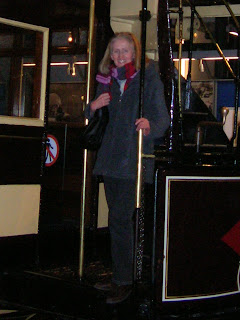
... the Seven Dials area of Covent Garden .... "Seven Dials, Covent Garden – London's most fashionable shopping area", according to their website, and with quite a history if you have time to explore the site ... we finally found our way to the London Transport Museum. This is an excellent museum, with rather a lot squeezed into the space available.
This is the example of the famous Routemaster bus in the exhibition. The no.11 is my favourite bus route - the full length of the route goes from Fulham in west London, via the Kings Road (very posh shops) to Victoria, whence to Parliament Square, Whitehall, the Strand, past St Paul's Cathedral and through the City of London to Liverpool Street Station. It can be a much more interesting ride back to Liverpool Street on the way home than using the Circle Line!
This bus would attract some very odd looks if it were to make its way along the A12 to Romford today.
Someone is a dedicated follower of fashion ...
A piece in the Times newspaper for 1st January 2009 covered some of the new regulations that came into force yesterday. Amongst them is one about the use of flares during night time rescue work. This is now forbidden, having been overtaken by the use of night vision goggles by many of the agencies involved in such work. However, a sentence in the Times report clarified that the wearing of flared trousers by rescue crews was not covered by this ban on flares.
A happy and blessed new year to the readers of this blog.
Sunday, 21 December 2008
Second Adolescence: or ice skating
Thursday, 17 April 2008
Apostolic visit to West Yorkshire
Where am I going to be for the next couple of days? Haworth. Follow the link to the Brontes. I have read everything by Charlotte, but not succeeded in finishing anything by Anne or Emily.
St Anne's, Keighley, is where I am expecting to be at Mass this Sunday (probably Saturday evening, actually).
And on our way back we intend calling on Isaac Newton - well, his birthplace at least. I have to remember to buy some apples to provide the materials for a suitable photo opportunity!
So my next post is likely to be on Sunday or Monday.
Sunday, 10 February 2008
Ice skating and second adolescence
This photo taken from beside the ice rink...
To prove we did reach the top...
We finished the day with a real dose of adolescence, at the Greenwich Picture House (see review below). No popcorn, though. We shall have to have another go at this cinema thing ...