Showing posts with label Eucharistic Adoration. Show all posts

Monday, 1 May 2023

Lourdes 2023

We recently returned from a five day visit to Lourdes, staying in a hotel we have used in the past but which had changed ownership since our last visit. Judging from their occupancy during the second week after Easter - ie very early in the pilgrimage season - Lourdes has bounced back reasonably well from the COVID pandemic.  The number of coaches parked also suggested healthy visitor numbers. The French version of the shrine website lists a full pilgrimage programme across the season, which is also an indication of a recovery in the fortunes of the town.  

During our five days in Lourdes, several large French pilgrimages were present. The International Mass on the Wednesday saw the underground basilica with standing room only. The celebrating bishop preached very ably on the pastoral theme of the shrine for this year: " ... that a chapel be built here ...". The video of the full celebration is on Youtube, with the homily beginning at 28:55 (only in French, but at the actual celebration itself, an English translation was shown on screens in the basilica). It was frustrating that the priests celebrating the daily Mass for English speaking pilgrims did not show any awareness of the pastoral theme.

The Eucharistic Procession is being introduced by the trumpet voluntary that I think was first used in Lourdes for the Jubilee of the Year 2000 - and it is followed by the invitation to those waiting at the altar on the prairie to kneel, if they are able, as the Eucharist is processed to the altar. The invitation is also repeated as the Eucharist arrives in the Underground Basilica for a time of silent adoration. I was reminded of an earlier post on this blog describing some of our other experiences of Eucharistic processions.

The torchlight procession on the Wednesday of our stay was as large as I have seen it on previous visits to Lourdes in July and August - though I must admit to finding the way in which the statue of Our Lady is wheeled up the ramps from the steps and into the Rosary Basilica at the end of the celebration a little comic.

On the Thursday of our stay, we walked up from Lourdes to Bartres, and sat for some time at the sheep fold. The skies alternated between A-400M military transport aircraft arriving and departing from the nearby airport and a pair of birds of prey circling - Gerard Manley Hopkins poem The Windhover came to mind as I watched the birds circle.

The Friday morning saw us pray the "high" Stations of the Cross, using the meditations of Benedict XVI for the Stations of the Cross at the Colosseum on Good Friday 2005. The way in which individuals, small groups and family groups can be seen visiting the Stations is an impressive witness to faith.

One of the consequences of Britain's departure from the European Union is that there is a (generous) limit to the number of days that British Citizens can spend in the EU without a visa. To audit a visitor's presence in the EU, British visitors now have their passports stamped by passport controls with the date of entry and again with date of departure. So our visit to Lourdes is now recorded by stamps in our passports.

Wednesday, 22 June 2022

Corpus Christi reminiscences

Last Sunday saw the celebration of the Solemnity of the Body and Blood of Christ, Corpus Christi. After the principle Mass in our parish there was a short Eucharistic procession round a block of the local streets, ending with Benediction in the garden outside the Church. Five photographs can be seen here. The parish's first communion children led the procession; an A5 sheet with the words of hymns to be sung during the procession was provided - though, as I suspect is quite typical of these occasions, the head of the procession tended to be singing a line or two ahead of those of us further back. During Mass we were treated to a homily that resoundingly affirmed belief in the real presence of Jesus Christ, true God, in the Eucharistic species.

Last Sunday's procession reminded me of when I was still at school, and a memory of a visit we made to a parish where an aunt was the housekeeper, for the Eucharistic procession in that parish. A procession in the nearby street was followed by Benediction in the garden beside the Church, more or less as happened on Sunday.

The day prompted us to reminisce about other occasions on which we had taken part in Eucharistic processions. One of the largest such occasions was during the International Eucharistic Congress in Quebec in 2008: International Eucharistic Congress: the Procession of the Blessed Sacrament. Another notable occasion was during a visit to Lake Como, when we were able to take part in the procession in  Bellano: Corpus Christi by Lake Como. We have also been in Assisi (twice if my memory serves me correctly) for the Solemnity, when we joined the parish in Rivotorto for Mass and a Eucharistic Procession. All of this takes place with Assisi itself overlooking the Church and the procession route. There are also the occasions when we have taken part in the Eucharistic procession in Lourdes: Following the Eucharistic Procession

Whilst it can be the larger celebrations that prompt the most vivid memories, it may well be the case that the celebrations which most deeply express the faith of the participants are the slightly makeshift efforts of ordinary parishes. I was reminded once again on Sunday last of Pope Francis' observation that manifestations of popular piety represent the inculturation of the Gospel in a particular place, and it appears to me that small parish processions do exactly this.

Sunday, 10 October 2021

The Synodal Journey

The BBC are reporting the opening by Pope Francis of the journey towards the Synod of Bishops meeting on synodality under the headline: Pope Franics launches mass consultation on Church reform. That is of course, a gross mis-representation of the intention of the Synodal journey. The BBC reports' citation of a "progessive" and a "conservative" voices demonstrates this mis-understanding:

Some Catholics hope it will lead to change on issues such as women's ordination, married priests and same-sex relationships.

Others fear it will undermine the principles of the Church.

I do recommend reading, instead of the BBC report, the two addresses by Pope Francis in relation to the Synodal journey.

The first is a "moment of reflection" for the opening of the Synodal journey, held in the New Synod Hall on Saturday 9th October. Here Pope Francis speaks about each of the three key words that express more concretely the notion of synodality: communion, participation and mission.

The second is Pope Francis' homily at Mass celebrating the opening of the Synodal journey.

You need to read these in their entirety, if you are to gain a true sense of Pope Francis' intentions with regard to the Synodal process. The BBC report could be covering an event on a different planet! 

The following quotations are only part of the story, though they are the parts that have caught my attention on a quick reading.

How Pope Francis understands the idea of a "listening Church" - prayer and adoration:

The Synod then offers us the opportunity to become a listening Church, to break out of our routine and pause from our pastoral concerns in order to stop and listen.  To listen to the Spirit in adoration and prayer.  Today how much we miss the prayer of adoration; so many people have lost not only the habit but also the very notion of what it means to worship God!  To listen to our brothers and sisters speak of their hopes and of the crises of faith present in different parts of the world, of the need for a renewed pastoral life and of the signals we are receiving from those on the ground.....

As we initiate this process, we too are called to become experts in the art of encounter.  Not so much by organizing events or theorizing about problems, as in taking time to encounter the Lord and one another.  Time to devote to prayer and to adoration – that form of prayer that we so often neglect – devoting time to adoration, and to hearing what the Spirit wants to say to the Church.  Time to look others in the eye and listen to what they have to say, to build rapport, to be sensitive to the questions of our sisters and brothers, to let ourselves be enriched by the variety of charisms, vocations and ministries.  Every encounter – as we know – calls for openness, courage and a willingness to let ourselves be challenged by the presence and the stories of others. 

How Pope Francis understands the idea of "discernment" - adoration, prayer and the word of God:

The Synod is a process of spiritual discernment, of ecclesial discernment, that unfolds in adoration, in prayer and in dialogue with the word of God.  Today’s second reading tells us that God’s word is “living and active, sharper than any two-edged sword, piercing to the division of soul and spirit, of joints and marrow, and discerning the thoughts and intentions of the heart” (Heb 4:12).  That word summons us to discernment and it brings light to that process.  It guides the Synod, preventing it from becoming a Church convention, a study group or a political gathering, a parliament, but rather a grace-filled event, a process of healing guided by the Spirit.  In these days, Jesus calls us, as he did the rich man in the Gospel, to empty ourselves, to free ourselves from all that is worldly, including our inward-looking and outworn pastoral models; and to ask ourselves what it is that God wants to say to us in this time.  And the direction in which he wants to lead us.

Tuesday, 18 May 2021

Novena for Pentecost: Baptism in the Spirit and prayer, Scripture and the Sacraments

People who have been baptised in the Spirit typically manifest a great love for Scripture, expressed in Bible studies and an anxiety to read the Scriptures in order to discover a relevance that can guide in every day life. Teaching is often strongly biblical in character. Again, while this faithfulness to Scripture is a feature of the Renewal, it also reflects something that can be seen in the wider life of the Church - for example the "Gospel Questions and Inquiries" of Fr Bernard Basset SJ, with their "see, judge, act" structure, and the meditations of the Spiritual Exercises.

Alongside this faithfulness to Scripture there is also a renewed awareness of the presence of Christ in the sacraments of the Church, particularly the sacraments of Penance and the Eucharist. Attending Mass and participating in prayer in the presence of the Eucharist are features of the Renewal. Again, the growth in Eucharistic Adoration and the frequenting of the Sacrament of Penance can be seen in other aspects of Catholic life, the events of recent World Youth Days being a prominent example.

For many, certainly in the early days, the main means of contact with the Renewal was through taking part in the regular meetings of a local prayer group. This is an event that moves the experience of prayer to less a matter of routine (though, in itself, that is not a bad thing) towards more a spontaneous response of love and gratitude to God and a confidence in his grace in providing for all our needs.

If we want to understand how Baptism in the Spirit gives rise to a particular style of life in the Church, it is important to place all three of these elements (appreciation of Scripture, sacramental life, prayer group) together and to see, for example, the life of a prayer group in its orientation towards the liturgical celebrations in which its members also participate. 

Sunday, 13 December 2020

Taking the knee?

 I have a memory of a remark made by Pope Francis early in his pontificate. It was to the effect that popular piety represented the inculturation of the Gospel. I found it an interesting observation at the time, as it suggested an understanding of inculturation that reflected an experience of the ordinary faithful rather than a "project" to be promoted in the Church. What it also suggested was a valuing of those events such as processions and popular festivals, not just as public celebrations of a particular culture, but as lived expressions of the Catholic faith that lies behind them. Pope Francis' remark suggested that we should value such expressions of culture as also being expressions of Christian faith. 

However, a difficulty arises when the form of the cultural expression becomes distanced from a lived experience of Christian faith. Perhaps the most clear example of this is the secular celebration of Christmas in  the developed nations, where the assertion that Christmas is "all about the family getting together" rather overtakes the religious concept of it as a celebration of the birth of Jesus Christ. (As an aside, I often wonder how I would have coped if I had been brought up in Ireland, where large Sunday Mass attendances I have seen during holiday visits have always seemed to suggest a deep faith on the part of the people that was not reflected in the celebrating clergy, leaving me wondering just how much was culture and how much was faith.)

So it is always helpful to remind ourselves of the faith-filled meaning of those gestures that can all too readily become just a habit, a product of a culture. Just as I ask myself exactly what each of those football players feel they are marking when the "take the knee" at the start of their match (and I suspect it is varied), I also ask myself what each of us feels we are marking as we genuflect towards the tabernacle as we enter and leave a Catholic Church. One of the tell tale signs of a culture only weakly informed by faith is the genuflection directed towards the front of the Church when the tabernacle is in a side chapel!

When he offered a catechesis on adoration as part of his homily at the closing Mass of the World Youth Day in 2005, Pope Benedict XVI did not intend it to be an explanation of the genuflection that we direct towards the tabernacle. Hearing it live, though, it immediately struck me as providing exactly that - an understanding of genuflection as an act of adoration, an act of both going down (submission) and loving embrace.

The Body and Blood of Christ are given to us so that we ourselves will be transformed in our turn. We are to become the Body of Christ, his own Flesh and Blood.

We all eat the one bread, and this means that we ourselves become one. In this way, adoration, as we said earlier, becomes union. God no longer simply stands before us as the One who is totally Other. He is within us, and we are in him. His dynamic enters into us and then seeks to spread outwards to others until it fills the world, so that his love can truly become the dominant measure of the world.

I like to illustrate this new step urged upon us by the Last Supper by drawing out the different nuances of the word "adoration" in Greek and in Latin. The Greek word is proskynesis. It refers to the gesture of submission, the recognition of God as our true measure, supplying the norm that we choose to follow. It means that freedom is not simply about enjoying life in total autonomy, but rather about living by the measure of truth and goodness, so that we ourselves can become true and good. This gesture is necessary even if initially our yearning for freedom makes us inclined to resist it.

We can only fully accept it when we take the second step that the Last Supper proposes to us. The Latin word for adoration is ad-oratio - mouth to mouth contact, a kiss, an embrace, and hence, ultimately love. Submission becomes union, because he to whom we submit is Love. In this way submission acquires a meaning, because it does not impose anything on us from the outside, but liberates us deep within.

I was, of course, also struck as a physicist by Pope Benedict's use of an analogy of nuclear fission earlier in the homily, when talking about the transformation achieved in the Eucharistic celebration:

By making the bread into his Body and the wine into his Blood, he anticipates his death, he accepts it in his heart, and he transforms it into an action of love. What on the outside is simply brutal violence - the Crucifixion - from within becomes an act of total self-giving love. This is the substantial transformation which was accomplished at the Last Supper and was destined to set in motion a series of transformations leading ultimately to the transformation of the world when God will be all in all (cf. I Cor 15: 28).

In their hearts, people always and everywhere have somehow expected a change, a transformation of the world. Here now is the central act of transformation that alone can truly renew the world:  violence is transformed into love, and death into life.

Since this act transmutes death into love, death as such is already conquered from within, the Resurrection is already present in it. Death is, so to speak, mortally wounded, so that it can no longer have the last word.

To use an image well known to us today, this is like inducing nuclear fission in the very heart of being - the victory of love over hatred, the victory of love over death. Only this intimate explosion of good conquering evil can then trigger off the series of transformations that little by little will change the world.

Pope Benedict's explanation of adoration can help us to achieve exactly that inculturation of the Gospel in an act of piety - genuflection towards Jesus present in the Eucharist  - foreseen by Pope Francis 

Sunday, 9 September 2018

Auntie Joanna's Adoremus Diary: a glorious celebration of the Eucharist

Read here.
More? Of course there was more. A pleasant meal with family and friends. Nightfever at the Blessed Sacrament shrine, packed with people, glittering with candles. Liverpool streets filled with Saturday night revellers, girls on hen nights, much shrieking and shouting. And some of them – many of them, the most unlikely of them – came in to pray, invited by the young congress teams.
As I post, the Eucharist is being carried in procession through the streets of Liverpool.

Saturday, 8 September 2018

Adoration may seem useless....

...but the world needs it desperately.

I link to this article in connection with the National Eucharistic Congress and Pilgrimage taking place in Liverpool today.

Coverage, with video clips that you can watch, here: https://www.shalomworldtv.org/adoremus

Friday, 7 September 2018

Adoremus: National Eucharistic Congress and Pilgrimage

This coming weekend sees the National Eucharistic Congress for England and Wales, being held in Liverpool: Adoremus.

Coverage of the Congress can be found here: http://www.shalomworldtv.org/adoremus.

You can also watch it on the homepages of these websites:
 

LIVE Broadcast dates and time as below,
 
FRIDAY, 7th September
10:00AM to 2:00PM
 
SATURDAY, 8th September
10:00AM to 2:00PM
 
SUNDAY, 9th September
11:00AM to 1:00PM
 

The Eucharistic procession through the streets of Liverpool on Sunday will remind me of my own participation in similar processions (I often happen to be away on holiday at the time of the Solemnity of Corpus Christi, so get the opportunity to participate in processions  in different places):

International Eucharistic Congress 2008 in Quebec.

The parish of Rivotorto, near to Assisi (twice).

Lisieux, at the Basilica dedicated to St Therese.

Bellano, on Lake Como.

Thursday, 7 June 2018

Corpus Christi by Lake Como

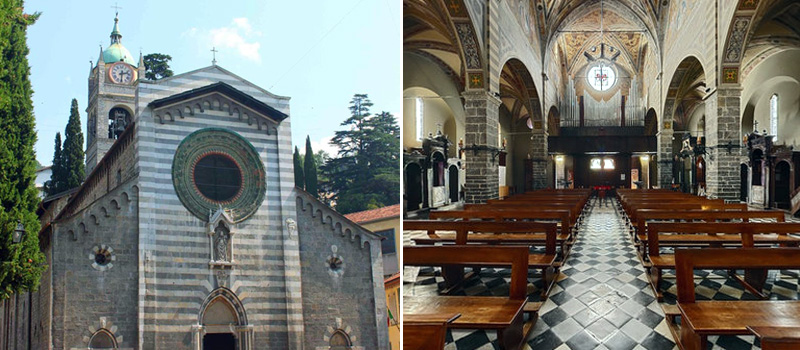
I recall that, early in his pontificate, Pope Francis observed that it is popular devotions that represent the inculturation of the Gospel in a particular place. I was reminded of this last week when Zero and I were able to take part in the celebration of the Solemnity of Corpus Christi in the town of Bellano on Lake Como. We had noticed earlier in the week a notice of the celebration of the feast to take place on the Thursday at the Church of Saints Nazaro and Celso in the town square.


A solemn Mass, at a level that might have been typical of a reasonably capable parish, was celebrated at 8 pm. Ambrosian Rite (scroll down the page to find an account of the differences of the Ambrosian Rite from the Roman Rite), including with the particular Eucharistic Prayer that that rite has for the celebration of Maundy Thursday and other Eucharistic feasts. I particularly noticed the manner of the incensations (you can't really miss it!) and the blessing of the readers.

As Zero expressed it, the parish priest was someone who visibly communicated the joy of Christ (I'm not sure how well I translated that into Italian for him at the end of the procession!). The first communion children and their families were out in force, and there was a comfortably full Church. There was a choir, and three concelebrating priests. Parishioners seemed to be very familiar with the hymns being sung.

At the end of Mass we all moved out of the Church to form up outside for the Eucharistic procession. This was well organised - we were organised to walk in two lines at either side of the road, led by a cross and candles, with the town band about half way down the procession and the Blessed Sacrament carried under its canopy towards the rear. Loudspeakers carried on poles ensured that all could hear the meditations (on Gospel accounts of the meetings of Jesus with people on the roads), and the band played gentle music during times of our own meditations. The procession followed a loop around the town, including along the main lake side provincial road which was closed for half an hour or so. At the lake, there was a pause while the lake was blessed with the Blessed Sacrament, and a prayer offered of both thanksgiving for the lake and sorrow for those who have died in accidents on the lake.

And then back to the Church, through the narrow lanes of the town, for concluding prayers and Benediction. As we all left the Church, the town band played a short concert in the square outside.

Over the years, Zero and I have taken part in several Eucharistic processions during our holidays - one year at Rivotorto parish during a visit to Assisi and on another occasion at the International Eucharistic Congress in Quebec in 2008. Bellano provided an experience as moving as any of them.

Sunday, 26 May 2013

Spirit in the City: 12-15 June 2013

In one of its earlier years, I took part in this (now annual) festival in the West End of London. If I recall correctly, this involved me in an afternoon of street evangelisation and particpating in the Eucharistic procession.

In more recent years, the coincidence of the festival with the school half term has meant that I have been out of the country at the time. This year, I am again out of the country (well, in Wales at least, and for work not holiday) for the Wednesday to Friday. I am hoping to be able to take part in the Saturday afternoon and closing Mass at Leicester Square.

According to the print flyer:
Catholic parishes, various Catholic communities and other Christian movements come together to pray, celebrate and evangelise in a variety of ways.

Spirit in the City celebrates the GOOD NEWS of Christianity and welcomes people of all faiths, ages and walks of life. It gives an opportunity to raise deeper questions about life and to search for new ways to connect with God and others around us.
Each year this festival prompts me to reflect on the catholic nature of the Catholic faith. At a first level, there is the participation of Catholics from different cultural and national backgrounds. And then, within this range of backgrounds, there are present the permanent elements of Catholic life - Marian character, Eucharistic character, Sacrament of Penance. It is of the catholicity of the Catholic faith that it should speak to each and every culture and time, and not be restricted to any one culture and time to the exclusion of others. With its different ministries, Spirit in the City does exactly this. It offers a lived experience of a "hermeneutic of continuity" - the permanent elements of the Catholic faith presented in a new and lively way.

This year Spirit in the City will take a particular message from the witness of Pope Francis, whose impulse towards evangelisation rather than introspection on the part of the Church, is clearly reflected in an event such as Spirit in the City.

If you are able to take part in one or more of the events of the four days, I highly recommend them to you. The website with details of the four days (full programme can be found from one of the tabs at the top of the home page, and there is also a poster/flyer for download) is here: Spirit in the City.

Monday, 19 November 2012

Dates for the Diary

At their recent plenary meeting, the Bishops Conference of England and Wales asked the faithful of their dioceses to observe two days of prayer.

The first is for peace in the Middle East, and is to be marked on the feast day of St John Damascene, and has gained an added urgency in the light of the Israeli assault on Gaza:
Conscious of the civil war in Syria and its impact on neighbouring countries, as well as the continuing conflict in the Holy Land, the Bishops’ Conference asks that a day of prayer for peace in the Middle East be observed on 4 December 2012, the Feast of St John Damascene.
The second is a day of prayer for the victims of trafficking and those who work to combat it, to be marked on the feast day of St Josephine Bakhita:
The Bishops’ Conference commends the request to observe the Feast of St Josephine Bakhita - 8 February - as a Day of Prayer for Victims of Trafficking and those who work to combat it.
It wold be nice if these days were to be marked by times of prayer in parishes, perhaps before the Eucharist. One dimension of times of Eucharistic Adoration is that of intercession at a time of urgent need, and these two intentions would reflect that dimension of Eucharistic Adoration. Individuals could also try to make a special effort to attend Mass on these days.

The choice of feast days, and the appropriateness of the lives of the saints involved for the intentions of prayer suggested for these days, reminds us of the universality of the Catholic Church, a universality in both space and time. The participation of individuals and ecclesial communities in these days of prayer would also express a readiness of communion with their bishops.

Saturday, 20 October 2012

Today's Gigs

Out of the three possible gigs today - A Future that Works, Aid to the Church in Need's annual event at Westminster Cathedral, and the procession of the Blessed Sacrament from Westminster Cathedral to Southwark Cathedral - I made the first and the last.

For the first, branch officers from London branches of my trade union had been asked to volunteer to join the union's contingent of stewards for the day. So, below, is yours truly on duty outside Westminster underground station. I am not expecting to be asked again to stand in the middle of the road outside of the Houses of Parliament waving my arms around to direct crowds. It was a fun day, though obviously with a very serious point being made. [NB. The TUC insist on having the pink high visibility vests back, so I don't have it as a souvenir.]


At the end of our stint, I managed to walk along to Westminster Cathedral in time to join the Blessed Sacrament procession, something I hadn't expected to do. The procession was well attended, the crowd filling St George's Cathedral for benediction at the end of the procession.

Thursday, 29 September 2011

Where to be on Saturday


To celebrate the first anniversary of the Beatification of Blessed John Henry Newman, and the 2010 visit of Pope Benedict XVI to Britain a Blessed Sacrament Procession will take place on Saturday 1 October.

The procession will leave Westminster Cathedral at 1.30pm via Ambrosden Avenue and continue along Francis Street, Vincent Street, Horseferry Road and Lambeth Bridge to St George's Cathedral Southwark.

At 2.30pm there will be Benediction at St George's Cathedral, Southwark.

All are welcome. Come and honour the Blessed Sacrament and witness to the reality of the presence of Christ in London.
The above is taken from the Westminster Diocese website. Westminster Cathedral's website suggests a slightly earlier start time of 1.15 pm.

I am hoping to be able to take part in this Procession on Saturday afternoon (the "moving in" to my newly installed kitchen permitting).

Wednesday, 14 September 2011

Of genuflections and bows

Fr Ray has a post here, along with its comments, that dicusses the relative merits of the bow and the genuflection as "signs of reverence" as the faithful approach to receive Holy Communion standing.

The first question that arises is that of whether a "sign of reverence" is appropriate as you approach to receive the Eucharist. Should we not make a sign of adoration? From a catechetical point of view, the first thing is to be clear in our own minds of the difference between a sign of reverence and a sign of adoration, and, then, to be clear about what we say in parishes about this difference. We might show reverence towards holy objects - a rosary, a crucifix, statues and perhaps particularly within the Church building the altar on which the Eucharist is celebrated. But adoration is given only to the persons of the Trinity, to God. And so we adore the Holy Eucharist, the true Body and Blood of the Lord who reveals to us the Trinity.

The second question that arises is the inconsistency of our practice, both in the strictly Liturgical and in the devotional life of our parishes. The rubrics for the celebration of Mass expect a genuflection towards the tabernacle by the ministers at the start and end of Mass only, and by the priest twice at the Consecration and again just before Communion - so what to do if we pass before the tabernacle at another time during the course of the celebration? So, approaching the altar on which are present the Body and Blood of the Lord, the extraordinary minister ... bows to the altar? bows towards the Sacred species? Which is it that is actually taking place? Is the extraordinary minister reverencing the altar or adoring the Body and Blood of the Lord? And that inconsistency of practice extends to times outside of the Liturgy itself, particularly where the Eucharist is reserved in a tabernacle that is not within the main sanctuary of the Church and where the idea of genuflection almost completely disappears.

Particularly since 2005, when Pope Benedict's catechesis on adoration at World Youth Day struck me as being a wonderful teaching about the nature of genuflection as an act of adoration, I have tried to make of genuflection the two-fold act of adoration of which Pope Benedict spoke: a going down before the God who is our creator and who is so much greater than we are, and an act of union/communion with God. This two-fold movement abolishes any artificial contrast between a so-called "dynamic" understanding of the Eucharist manifested in receiving the sacred species and a so-called "static" understanding manifested in adoration outside of the celebration of Mass. This determines that the act that it is most appropriate to make towards the Eucharistic species and towards the tabernacle is a genuflection, as an act of adoration.
I like to illustrate this new step urged upon us by the Last Supper by drawing out the different nuances of the word "adoration" in Greek and in Latin. The Greek word is proskynesis. It refers to the gesture of submission, the recognition of God as our true measure, supplying the norm that we choose to follow. It means that freedom is not simply about enjoying life in total autonomy, but rather about living by the measure of truth and goodness, so that we ourselves can become true and good. This gesture is necessary even if initially our yearning for freedom makes us inclined to resist it.
We can only fully accept it when we take the second step that the Last Supper proposes to us. The Latin word for adoration is ad-oratio - mouth to mouth contact, a kiss, an embrace, and hence, ultimately love. Submission becomes union, because he to whom we submit is Love. In this way submission acquires a meaning, because it does not impose anything on us from the outside, but liberates us deep within.

[Within the heritage of the Church there is a style of bow that can also be conceived as an act of adoration - the "profound bow" - but in the usual parish context of England and Wales this would not be the normal act of adoration (which is the genuflection). The "profound bow" is made from the waist, and brings the upper body horizontal - and I have occasionally seen this from a person who for reasons of health is unable to genuflect.]

With the exception indicated in parentheses, the bow is then a sign of reverence, and not a sign of adoration.

My first appeal would therefore be for a consistency in our use of language - we adore the Eucharistic species, and we reverence other sacred objects and, sometimes, persons. We should be asked for a sign of adoration as we approach to receive Communion, and, in the normal understanding of England and Wales, that would be a genuflection; and we should be asked to show reverence towards, for example, the altar in Church, the normal sign of which would be a bow.

And my second appeal would be for a corresponding consistency in practice, both during the celebration of the Liturgy itself and at times outside such celebration. This means always genuflecting in the presence of the Eucharistic species, and not doing anything that makes it appear that a bow towards the Eucharistic species is correct practice.

The outcome might be some considerably less confused parishioners ....

[Postscript: There are, I realise since first publishing this post, one or two situations where the custom is to genuflect, without that genuflection being an act of adoration - but they are situations where the genuflection is associated with the words at that time being said. Within the Liturgy, I think of the genuflection on Christmas Day and on the Solemnity of the Annunciation during the recitation of the creed. In devotional life, I think of the genuflection during the praying of the Angelus. To really get this, the dear person in the pew does need to be aware of the difference between an act of reverence and an act of adoration.] 

Monday, 20 September 2010

P+2: eyewitness accounts

In case you have lost track, P+2 was Saturday, the day of Mass at Westminster Cathedral, drive up the Mall and Vigil in Hyde Park.

Zero and I duly set off for London as planned. On the Central Line going up we encountered other groups with their "pilgrim pack" bags and other Papal paraphernalia on the way to the Vigil. We arrived a few minutes late for our film - Certified Copy - but weren't likely to disturb the other nine people watching it in a cinema that could seat 160. The film is very cerebral - or, as Zero probably more perceptively expressed it, "a strange film". One novel - and very contemporary - aspect of the film is that uses pretty much equally English, French and Italian. Subtitles, of course, but it will be a very different experience if you do not have some understanding of French and Italian as well as English. But in this era of European unity, why should we not watch a film in three languages?

We emerged from the cinema on to Piccadilly at about 3.45 pm. The tail end of the Protest the Pope march, due to set off from Hyde Park Corner at 1.30 pm, was just reaching Piccadilly Circus. This means that, assuming it set off on time, there were sufficient protestors for the march to take about 2 hours to go by any single point. Estimates of numbers that I have seen are 10 000 and 20 000 - but certainly what one would call a good turnout. It has to be said that, despite the nastiness and anti-Papal ridicule of some of the placards, the atmosphere was very good natured. My guess is that the march will have been finishing at Downing Street somewhere soon after 5 pm, when the Holy Father was due to set off from Horse Guards Road (pretty much literally 5 minutes walk away) at 6 pm for his drive along the Mall.  I think it is to the credit of the protestors that they appear to have dispersed and not made any attempt to continue their protest during Pope Benedict's drive and the Hyde Park vigil.

After seeking physical food, Zero and I crossed Trafalgar Square to go to the Mall for the Papal Drive, getting there about 45 minutes before the Popemobile was due to set off. There was lovely sunshine, key vantage points along the barriers already occupied and others claiming their place beside the barriers in anticipation of a close up view. We walked up to Buckingham Palace, and then back down towards Admiralty Arch to position ourselves about one third of the way up the Mall. A wonderfully calm and tranquil atmosphere as people waited and others strolled up and down.


The Mall was lined from end to end. There were two signs that the Holy Father had arrived at Horse Guards Road and was getting ready to set off on his Drive. The helicopters had arrived overhead; and everyone got their cameras ready. My photographs don't show the number of Papal flags very well - these again appeared as the time of the Drive approached. In the event, there was no great roar or applause as the Pope approached and passed - because just about everyone had a camera in their hands! But that is not to underestimate the enthusiasm and commitment of those who turned out. I didn't try to get a photo, just wanting to enjoy the moment. At this point, I texted to my sister in Hyde Park: "HH has just waved at us".


As we then headed for home (Zero was putting me to bed early for the 2 am start on Sunday for Cofton Park), we found ourselves accompanied in the tube trains by others who had obviously come up to wave the Holy Father along the Mall.

Earlier in the day, my sister had travelled in to Victoria from south London with her older children. She described the walk from Victoria to Hyde Park as being rather like a procession - the pavements full of people all heading in the same direction, having to move slowly to keep with the flow. She saw no sign of any protestors, though they will have been setting off from Hyde Park Corner at about the time she arrived at Victoria. They stayed towards the back of the crowd, but enjoyed a really good experience. So far as I can gather, the staging in Hyde Park was tremendous; the testimony of Jimmy Mizen's parents intensely moving; and the silence for the time of Adoration quite stunning. My sister and the boys seem to have really enjoyed themselves, and she described them kneeling in adoration at the end of what will have been quite a long, busy day.

Thursday, 9 September 2010

Two heresies

Heresy number 1.

I like the sanctuary that has been designed for the Mass of Beatification of John Henry Newman in Cofton Park, Birmingham.


Heresy number 2.

I like "Shine Jesus shine", and, given the words, think it is very appropriate that it be sung at a vigil with Pope Benedict during a visit whose theme is "Heart speaks unto heart". So far as I can tell, it will be sung before the time of Eucharistic Adoration begins - but look at the words of the second verse and imagine them being sung before the Blessed Sacrament.
Lord, the light of Your love is shining
in the midst of the darkness, shining;
Jesus, Light of the World, shine upon us,
set us free by the truth You now bring us,
shine on me, shine on me.

Shine, Jesus, shine,
fill this land with the Father's glory;
blaze, Spirit, blaze,
set our hearts on fire
Flow, river, flow
flood the nations with grace and mercy
send forth Your word, Lord,
and let there be light.

Lord, I come to Your awesome presence
from the shadows into Your radiance;
by the blood I may enter Your brightness,
search me, try me, consume all my darkness.
Shine on me, shine on me.
 
As we gaze on Your kingly brightness
so our faces display Your likeness
Ever changing from glory to glory
mirrored here may our lives tell Your story.
Shine on me, shine on me.
Anathema sum?

Support for Pope Benedict XVI

It won't catch the headlines in the main stream media, but it is an expression of the extent of affection and support for the Pope from Catholics in the United Kingdom - and, quite possibly, from some non-Catholics as well.

More than 130 days of Eucharistic Adoration ...

6 300 financial donations to support the work of the Church in the Middle East ....

11 500 Mass offerings for the the Holy Father's intentions ....

32 000 decades of the Rosary ....
Aid to the Church in Need’s fundraising and marketing manager Patricia Hatton spearheaded the initiative.

She said: “This scheme has given a voice to all those benefactors who, in the face of media indifference and worse, believe strongly in the message of Christ. They are convinced that prayer has the power to strengthen the life of the Church.”

Meanwhile, many messages of support have come in to the charity’s office in Sutton, Surrey.

One message reads: “I am concerned that every opportunity should be taken to show the world, particularly the secular ascendancy here, that British Catholics are devoted to the Pope.”

Wednesday, 8 September 2010

Lourdes 4: the Lord's Day

Our recent visit to Lourdes was meant to be a pilgrimage as well as a holiday. The Sunday of our stay was designated a "religion" day.

This began with the International Mass at 9.30 am. The Diocese of Rome were on pilgrimage at the time, so the principal celebrant on this morning was the Pope's episcopal vicar for Rome. I hadn't quite realised that it is possible, each Wednesday and Sunday of the pilgrimage season, to follow the International Mass live on a web stream from the Lourdes shrine's website. It was interesting to see that the Our Father was sung in Latin - and that the congregation joined in with considerable energy. This seemed to me a much better idea than something I have previously experienced in Lourdes, which is pilgrims being invited to pray the Our Father in their own different languages. The undergound basilica was full for Mass, which I think puts the numbers attending at 20 000 people or thereabouts.

After a coffee, we then took ourselves off to pray the Stations of the Cross, using the "high stations". Our timing was good in that there were no large pilgrimage groups praying the stations at this time. One of the most powerfully evangelising aspects of a visit to Lourdes is when you see small groups, perhaps of two or three, following the stations in a prayerful way. On our visit, it was interesting to notice more pilgrims from the far East and the Asian sub-continent, who communicated a particular affection for the devotion of the stations as they prayed them. One or two people were climbing the hill in bare feet .... And, in front of the fifteenth station recalling the Resurrection, we were asked to take a photo of a group of about a dozen Italians, I expect on pilgrimage from one of the new ecclesial movements.

We used the meditations that Pope Benedict, Cardinal Ratzinger as he then was, prepared for the Colosseum on Good Friday in the year 2005.  I had used an adapted form of these meditations in the parish previously, but they were very rich meditations to use, and pray together, in Lourdes.

When we took part in the Eucharistic Procession that afternoon, we waited under the arches by the grotto for the procession to pass, with the intention of joining at the end after the Blessed Sacrament had passed. The procession starts at 5 pm. It was 5.50 pm before the procession had passed us and we could follow on behind the Blessed Sacrament - which gives some idea of the numbers taking part. Again, the underground Basilica was full for the occasion.


The Rosary procession was rather smaller (the Saturday evening procession had, I think, been much larger). We walked it, with the inevitable distractions to prayer that that entails.

My observation to our host at the hotel the next morning was to say: "Nous n'avons plus les genoux".

Tuesday, 31 August 2010

Lourdes 1: or, where have I been for the last week?

Zero and I have just returned from a 7 night stay in Lourdes, a stay intended as both a pilgirmage and a holiday. Our first day, spent in Pau, was somewhat damp to begin with and then got brighter.

In visiting the main Church in the town centre we found leaflets advertising perpetual adoration of the Blessed Sacrament at the Church of St Therese, and duly walked the kilometre or two to reach the said Church. Perpetual adoration was begun in November 2009 at the request of the Bishop of the diocese (Bayonne, Lescar and Orlon - Mgr Aillet), to pray particularly for priestly vocations.

When we arrived, there was no-one present before the Lord (oops! - and this despite what appeared to be an efficient system of regularly committed adorers and substitutes). We stayed for thirty minutes, and someone arrived to take over as we left. I signed the book they had for "occasional adorers", adding the word "Angleterre" after our names.

My own photograph of the exterior of the Church is below; there are some photographs of the interior of the Church here.


This is my photograph of the Adoration Chapel, accessible from the entrance area of the Church, on the right.


The leaflet for the perpetual adoration contains the following quotation from Cardinal Tauran, who is, I believe, the President of the Pontifical Council for Inter-religious Dialogue.
Un monde sans adoration, serait un monde a la seule mesure de l'homme ... Un monde sans adoration n'est pas seulement irreligieux; c'est un monde inhumain.  [A world without adoration, that would be a world whose only measure is man ... A world without adoration is not only irreligious; it is a world that is inhuman.]
After our time of adoration, we betook ourselves to C&A. The branch in Pau is housed in a modern shopping precinct and lacked the historic grandeur of the last C&A branch we visited - in Prague, on Wenceslaus Square. The balcony of the building that now houses C&A in Prague was the balcony on which Vaclav Havel and Dubcek appeared at a key moment in the "velvet revolution".

Now, which constituted the real pilgrimage - the walk out to St Therese and back or the visit to C&A - is a moot point!

Friday, 9 July 2010

Catholic Travellers Renewal

... is the title of an article in Good News, the magazine of the Catholic Charismatic Renewal in the UK.

Two particular paragraphs caught my attention. The first was because of its reference to the Appleby Horse Fair, about which I have posted in the past. The woman referred to is Margaret, about whom the article in Good News largely centres:
A woman of deep prayer and mystical experiences, several years ago she had a vivid dream that the Lord was calling her to set up a tent with Eucharistic adoration at the Appleby Horse Fair in Cumbria, to which 30,000 Gypsies, Romanies and Travellers come every year, as a witness to his presence among his people. The first couple of years it was just herself and a friend leading the outreach, backed by Charlie Connor from Youth2000 and the Franciscan Friars of the Renewal, but this last year, a much bigger team of Travellers gave their services, due to the growth of the Charismatic Renewal among them over the last nine months or so, as well as support from the local parish priest of Appleby Fr Aleks.
And it was the rather no-nonsense approach to the clergy that caught my attention in this paragraph:
The meeting had been called because the Travellers wanted to share with their chaplain, Fr Joe Brown, a laid back bespectacled Irish priest, their dream to build a church for the Traveling People in the UK. Fr Joe had just suggested that, rather than the big £3 million white twin towered church they had in mind, it would be more sensible to settle for a small prayer centre or a disused parish somewhere instead. But they were having none of it. They wanted to build something big and beautiful for the glory of God.
If you read the article in full you will see that the lay faithful are probably going to get what they want ...