Showing posts with label Ark of the Covenant. Show all posts

Friday, 21 November 2008

Visit to the John Fisher School (part 4)

The fourth - and last - instalment of the talk at John Fisher School.
3 … for the Life of the World

3.1 The Eucharist: memorial of the Paschal Mystery that takes away our
sins

112. What is the importance of the Paschal Mystery of Jesus?
The Paschal Mystery of Jesus, which comprises his passion, death, resurrection, and glorification, stands at the centre of the Christian faith because God's saving plan was accomplished once for all by the redemptive death of his Son Jesus Christ.

280. In what way is the Eucharist a memorial of the sacrifice of Christ?
The Eucharist is a memorial in the sense that it makes present and actual the sacrifice which Christ offered to the Father on the cross, once and for all on behalf of mankind. The sacrificial character of the Holy Eucharist is manifested in the very words of institution, “This is my Body which is given for you” and “This cup is the New Covenant in my Blood that will be shed for you” (Luke 22:19-20). The sacrifice of the cross and the sacrifice of the Eucharist are one and the same sacrifice. The priest and the victim are the same; only the manner of offering is different: in a bloody manner on the cross, in an unbloody manner in the Eucharist.

1 Corinthians 11:23-26
For I received from the Lord what I also delivered to you, that the Lord Jesus on the night when he was betrayed took bread, and when he had given thanks, he broke it, and said, "This is my body which is for you. Do this in remembrance of me." In the same way also the cup, after supper, saying, "This cup is the new covenant in my blood. Do this, as often as you drink it, in remembrance of me." For as often as you eat this bread and drink the cup, you proclaim the Lord's death until he comes.
The Ark of the New Covenant is decorated with the following icons: the Last Supper, the Crucifixion and death of Jesus, the Vigil of Mary (when she waits through Holy Saturday until the Resurrection on Easter morning), and the Resurrection.


3.2 The Eucharist: food for our life in the world, food for the life of others in the world

292. What are the fruits of Holy Communion?
Holy Communion increases our union with Christ and with his Church. It preserves and renews the life of grace received at Baptism and Confirmation and makes us grow in love for our neighbor. It strengthens us in charity, wipes away venial sins and preserves us from mortal sin in the future.

John 6: 32-35, 49-56
Jesus then said to them, "Truly, truly, I say to you, it was not Moses who gave you the bread from heaven; my Father gives you the true bread from heaven. For the bread of God is that which comes down from heaven, and gives life to the world." ….

I am the bread of life. Your fathers ate the manna in the wilderness, and they died. This is the bread which comes down from heaven, that a man may eat of it and not die. I am the living bread which came down from heaven; if any one eats of this bread, he will live for ever; and the bread which I shall give for the life of the world is my flesh." "Truly, truly, I say to you, unless you eat the flesh of the Son of man and drink his blood, you have no life in you; he who eats my flesh and drinks my blood has eternal life, and I will raise him up at the last day.

Matthew 25:34-40
Then the King will say to those at his right hand, `Come, O blessed of my Father, inherit the kingdom prepared for you from the foundation of the world; for I was hungry and you gave me food, I was thirsty and you gave me drink, I was a stranger and you welcomed me, I was naked and you clothed me, I was sick and you visited me, I was in prison and you came to me.' Then the righteous will answer him, `Lord, when did we see thee hungry and feed thee, or thirsty and give thee drink? And when did we see thee a stranger and welcome thee, or naked and clothe thee? And when did we see thee sick or in prison and visit thee?' And the King will answer them, `Truly, I say to you, as you did it to one of the least of these my brethren, you did it to me.'

The Ark of the New Covenant is decorated with the following icons: the multiplication of the loaves, the Washing of the disciples feet, the disciples meeting Jesus on the road to Emmaus.

Wednesday, 19 November 2008

Visit to the John Fisher School (part 3)

This is the third instalment (but the end of part 2) of the notes of my talk on the Eucharist. I had intended highlighting during the talk the question about Jesus Christ having a true human body, but didn't do it as clearly as intended. It indicates a fulfilment, in the mystery of God's becoming man, of the original covenant with creation represented by Noah. Physical matter - the forms of bread and wine in the Eucharist - will be the way in which God comes to us in the Eucharist, too, so that again can be seen as flowing from the original covenant with creation.


2.3. The New Covenant: Jesus Christ

9. What is the full and definitive stage of God's Revelation?
The full and definitive stage of God’s revelation is accomplished in his Word made flesh, Jesus Christ, the mediator and fullness of Revelation. He, being the only-begotten Son of God made man, is the perfect and definitive Word of the Father. In the sending of the Son and the gift of the Spirit, Revelation is now fully complete …

82. Why is Jesus called “Christ”?
“Christ” in Greek, “Messiah” in Hebrew, means the “anointed one”. Jesus is the Christ because he is consecrated by God and anointed by the Holy Spirit for his redeeming mission. He is the Messiah awaited by Israel, sent into the world by the Father. Jesus accepted the title of Messiah but he made the meaning of the term clear: “come down from heaven” (John 3:13), crucified and then risen , he is the Suffering Servant “who gives his life as a ransom for the many” (Matthew 20:28). From the name Christ comes our name of Christian.

92. Did Christ have a true human body?
Christ assumed a true human body by means of which the invisible God became visible. This is the reason why Christ can be represented and venerated in sacred images.

John 1:1-3, 9-12, 14
In the beginning was the Word, and the Word was with God, and the Word was God. He was in the beginning with God; all things were made through him, and without him was not anything made that was made….The true light that enlightens every man was coming into the world. He was in the world, and the world was made through him, yet the world knew him not. He came to his own home, and his own people received him not. But to all who received him, who believed in his name, he gave power to become children of God; …. And the Word became flesh and dwelt among us, full of grace and truth; we have beheld his glory, glory as of the only Son from the Father.


The Ark of the New Covenant, used at the Eucharistic Congress, does not include a representation of the mercy seat of the Old Testament covenant. Instead, the upper part of the Ark shows a series of images relating to Jesus Christ - whose presence in the Eucharist replaces that represented in the mercy seat of the Old Testament covenant.

Thursday, 26 June 2008

International Eucharistic Congress: the Ark of the New Covenant

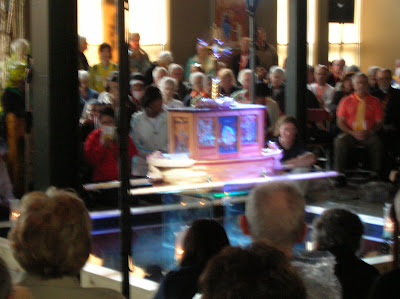
I have already posted on the Ark of the New Covenant, and its pilgrimage around parishes and communities of Canada in preparation for the Eucharistic Congress. Just before the celebration of the opening Mass of the Congress, the Ark was carried in to the hall being used for the main events. As it was carried in, a series of Old and New Testament readings were proclaimed - starting from the first moments of creation (the prologue to St John's Gospel); moving on to the Ark built by Noah (the Scripture passage read recounted the blessing of Noah and his family as they left the Ark after the flood); then on to Moses bringing the tablets of the Covenant to the people in the desert; next, the account of the institution of the Eucharist and the establishment of the new covenant; and concluding with John the Baptist as the witness to the light, who gave to all who listened to his word the power to become children of God. It was a wonderfully devised catechesis. A video clip of this part of the opening ceremony can be found here. (You will need French to be able to follow the Scripture passages. )

At the end of the opening Mass, the Holy Eucharist was placed atop the Ark and carried out in procession to the room/chapel that would be used for silent Adoration, 24/7 for the remainder of the time of the Eucharistic Congress. My photographs of the Ark in this adoration room/chapel - named the Chapel of the New Covenant for the duration of the Congress:


As an exercise in the new evangelisation, the design and then pilgrimage of the Ark of the New Covenant is only matched by the pilgrimage of the Cross and Icon of the World Youth Day.

Now, Dublin, you have something to live up to .....

Tuesday, 29 January 2008

International Eucharistic Congress 2008

Of the three major international Catholic celebrations taking place in 2008, the Eucharistic Congress seems to be the "cinderella". It takes place in Quebec, Canada, from 15th June to the 22nd June.
I do find it encouraging that the Congress is one of the centre piece events of the 400th anniversary year of the foundation of Quebec. In terms of civil policy (eg on same sex unions), Canada is not necessarily on the side of the angels. However, there does appear to be a positive collaboration between the Catholic Church and civil authorities in the arrangements for the Congress.
The theme of the Congress is "The Eucharist: gift of God for the life of the world". In the early stages of the preparation for the Congress, the young people of Canada asked for a symbol of the Congress that could be taken on visits to parishes, schools etc, during the time leading up to the Congress. They remembered the experience of the pilgrimage of the World Youth Day Cross leading up to the WYD in Toronto, and were looking for something similar. The result is the Ark of the Covenant, which is presently on a voyage of pilgrimage across Canada.

The Ark is shaped like a boat, and is designed to encourage the three strands of activity associated with a Eucharistic Congress :

Catechesis: The base of the Ark is shaped like the hull of a boat. The deck supports a rectangular coffer decorated with icons depicting Gospel scenes. These illustrations can serve as springboards for Eucharistic catecheses.
Liturgy: The roof of this structure is designed to hold either the Bible, or a monstrance containing the Blessed Sacrament. The Ark can be carried in procession, and used as a focus for prayer.
Commitment: The Ark is designed to receive commitment forms from the faithful, who will be invited to adopt a “Eucharistic Charter.”

The icons on the Ark are shown at http://www.cei2008.ca/en/archesymoblisme.

A delegation from England and Wales to the Eucharistic Congress will be led by Fr Julian Green of Birmingham Archdiocese. Do contact him for a booking form. The Congress website homepage can be found at http://www.cei2008.ca.