Friday, 18 November 2011

Brian Sewell (1): the pleasures of the flesh

The London Evening Standard printed an extract from Brian Sewell's forthcoming autobiography in its edition of 17th November 2011. It can be found on their website with the title: The sex life of Brian Sewell: Story of my 1000 lovers. In the print edition it had the title: "Easily a thousand sexual partners in a quinqennium". To date, there appears to have been very little reaction to the piece, or to the trailed accounts of the contents of the autobiography.

The later two-thirds or so of the extract published in the Evening Standard describes a catalogue of casual gay pick ups in the street, at parties and through introductions. There are a sprinkling of longer relationships, though the term relationship can only have a rather analogous meaning in the context. [It is not referred to in the Evening Standard extract, so I think I have encountered it in a review of the autobiography I have read, but there is also the suggestion that Brian Sewell was used as a kind of sexual bait by an employing art auction house when visiting and staying over with clients.]

There is something disguised behind the use of the term "lovers" in the title of the website posting of the extract; it is still disguised, but perhaps less so, in the print edition's use of the term "sexual partners". What is disguised in the title, but abundantly clear in the text itself, is the exploitative nature of Brian Sewell's activities (I hesitate to use the word "relationships" - it just doesn't seem to apply to the encounters being described). He is exploiting other men for his own satisfaction and others are no doubt exploiting him for their pleasure. The extract seems to recognise this, when Brian refers to his "metamorphosis from celibate to whore". The behaviours involved would probably have been recognised as exploitative at the time, in the years from 1959 onwards, to which Brian Sewell's account refers.

Today, I wonder whether we might use the word "abusive" to describe these activities. Procedures for the protection of children and vulnerable adults indicate behaviours ranging from neglect or failure in a duty of care, through a spectrum, to explicitly physical and sexual activity, as being relevant to their considerations. That the activities Brian Sewell describes took place between adults who had, we presume, consented - is this enough for us to take them out of the spectrum of neglectful-to-violent/sexual that would now be considered within the wider sense of the term "abuse"? Are the activities described neglectful of any real care towards the other man involved, in circumstances where freedom of will to consent may itself be impaired? The at least potentially abusive nature of these activities appears to be recognised by Brian Sewell, with his inclusion of the word "violence" and reference to opportunism in the following passage from the extract:
I learned that sex ranges from tenderness to violence, from the short and sharp to the night long, from the security of the bedroom to the thrilling risky business of doing it while standing up in a canoe, and that the opportunist must make his opportunities.  

Wednesday, 16 November 2011

New translation: "And with your spirit"

The change from "And also with you" to "And with your spirit" in the new English translation of the texts of the Roman Missal is perhaps iconic of the whole process of the new translation. Some would criticise it as being archaic, as part of a process of "putting the clock back"; others might argue that it is not a phrase that ordinary Catholics can understand. Those who are supportive of the new translation point out - rightly - that the new translation is more immediately faithful to the Latin original, and that it makes more transparent the Scriptural roots of the text, in this case, in the writings of St Paul. These latter two points apply to a number of different aspects of the new translation. My own experience suggests that the introduction of "And with your spirit" is now fairly well embedded in parishes, and has gained the instinctive status previously held by "And also with you".

Thinking Faith have just published what I think is the best consideration that I have seen of the significance of the phrase "And with your spirit".  I do not think there was much confusion about it among the ordinary faithful, as the lead paragraph of the article at Thinking Faith suggests. I found Fr Mahoney's account of the patristic and historical background to the suggestion that the phrase in some way relates to the grace of ordination of the celebrating priest very useful. I share with him the view that this interpretation seems fanciful and contrived.

It seems to me fundamentally correct to see the dialogue "The Lord be with you" /"And with your spirit" as being a greeting and a response to that greeting. This is the simple straightforward sense of how this dialogue occurs in the Liturgy, particularly at the beginning of the Eucharistic celebration. It has the nature of a greeting exchanged between the priest and the people.
Taken over into the Eucharist to express the people’s response to the celebrant’s greeting of, ‘The Lord be with you’, the phrase is to be understood fully as ‘And the Lord be with your spirit’.
It also seems to me correct to take the Scriptural origins of the phrase in a literal way, looking at how it occurs in the writings of St Paul. This does not, however, mean that we should underestimate its theological complexity. The account given by Fr Mahoney of St Paul's anthropology of body, spirit and soul is therefore, in my view, the correct way to explain the response and the one that is taken in the resource Become One Body One Spirit in Christ. I would want to add, perhaps, the suggestion that in writing of the "spirit" St Paul also refers to that in man which represents his orientation or openess towards God.

In passing, Fr Mahoney suggests that the debate about how the phrase "And with your spirit" is understood is a debate about whether the priest is seen as being separate from the people or as being one with them.
I wonder also if part of the modern popularity of this interpretation in terms of the grace of priestly ordination is because it can help to propagate the difference between priests and people which the Vatican Council tried so much to diminish and which others are now regrettably attempting to re-establish.
The reference to n.9 of the Decree on the Life and Ministry of Priests, where the community of life of the priest with the lay faithful is described, is quite apposite in giving a context to the greeting dialogue understood precisely as one of mutual greeting. I would not agree that, in this passage, Vatican II was making an effort to diminish the difference between priests and people, as this passage needs to be read alongside others in the Decree which discuss those particular gifts and office that a priest receives through ordination, and which do mark him out as different from the people. The relationship between priests and people as described in n.9 is one that should be our goal; but I do not think that it is reversed by a rightful consideration of the specific dignity of the priestly vocation through such initiatives as the Year for Priests.

Monday, 14 November 2011

Year of Faith (6): the profession of faith

The Year of Faith promulgated by Pope Paul VI in 1967-1968 came to its conclusion with the proclamation of what has since become known as the Credo of the People of God. Issued as a motu proprio, it was first declared by Pope Paul VI as the homily at the Eucharistic celebration that marked the end of the Year of Faith.

In Porta Fidei n.8, Pope Benedict XVI has also called on the Church, during a Year of Faith, to celebrate the profession of faith:
We will have the opportunity to profess our faith in the Risen Lord in our cathedrals and in the churches of the whole world; in our homes and among our families, so that everyone may feel a strong need to know better and to transmit to future generations the faith of all times. Religious communities as well as parish communities, and all ecclesial bodies old and new, are to find a way, during this Year, to make a public profession of the Credo.
The profession of faith has, in the life of the Church, three particular expressions. The first is the question and answer form associated with the sacrament of Baptism and with the Liturgy of Easter Sunday. The second is the form known as the Apostle's Creed, particularly associated with the Church in Rome and with textual sources that reach back to the fourth century, but whose articulation in the twelve articles we have today dates from the ninth century. The third is the Niceno-Constantinopolitan Creed, deriving from the Council of Constantinople in 381, which gained a usage within the Liturgy of both East and West.

The profession of faith is something that is a possession of the Church and, at the same time, a possession of the individual believer. It is not an accident that, as part of the preparation for Baptism, a catechumen recieves a copy of the Creed from the Church. The Catechism of the Catholic Church reflects this two-fold ownership of the profession of faith in its first section which is headed "'I believe' - 'We believe'".
167 "I believe" (Apostles' Creed) is the faith of the Church professed personally by each believer, principally during Baptism. "We believe" (Niceno-Constantinopolitan Creed) is the faith of the Church confessed by the bishops assembled in council or more generally by the liturgical assembly of believers. "I believe" is also the Church, our mother, responding to God by faith as she teaches us to say both "I believe" and "We believe"....
180 "Believing" is a human act, conscious and free, corresponding to the dignity of the human person.
181 "Believing" is an ecclesial act. the Church's faith precedes, engenders, supports and nourishes our faith. the Church is the mother of all believers. "No one can have God as Father who does not have the Church as Mother" (St. Cyprian, De unit. 6: PL 4, 519).

There is an interesting dynamic that arises from the wearing of an external sign of Christian faith, such as a cross or a witness wrist band. The wearing of such a sign is a witness, a testimony of faith. My own experience suggests that, primarily, this acts as a reminder or testimony to oneself; and that this reminder to oneself is much more significant than any witness or testimony that is given to others who might see the sign. What might be described as a question of conscience, or a  "moment of Christian witness", in this regard arises primarily in my view from this testimony of what one believes given to oneself and about oneself. The question of whether others see that testimony is secondary and not always of itself a question of conscience. [I would not, for example, insist on wearing a witness band on my wrist on a hospital ward which has a "bare below the elbows" policy as part of its infection control regime, being happy to remove the witness band before working on the ward and replacing it afterwards.] There is, though, a mutual interplay between the personal nature of this witness and its public nature; it is the wearing of the sign in public that provides the power of the witness to oneself. 

[There is a difference here between the Catholic who wears such a sign of witness and an evangelical Christian who might wear exactly the same sign, the difference arising from the ecclesial orientation of the Catholic witness compared to the highly individual witness of the evangelical Christian who lacks the Catholic sense of ecclesial adherence.]

The public profession of the Credo to which Pope Benedict calls the different communities in the Church enters precisely into this dynamic of witness and testimony. It is interesting that Pope Benedict refers to a "public profession" of the Creed. This might, of course, take the form of a Liturgical celebration. But could it not also take the form of a gathering in a public square in a city centre, so that the profession of faith is made in a visible way before others and before the world?

Wednesday, 9 November 2011

Gay activism and reversed intolerance

Alan Craig has posted an exchange of e-mails between himself and and the acting editor of Pink News, under the title Stonewall's Yellow Star? The e-mails make reference to an article that Alan wrote for the Church of England Newspaper, and which he also published on his blog.

I quote from the e-mail sent by Pink News to Mr Craig:
Concerns have been raised that, inter alia, an instruction for people to “rise up” against gay “leaders” could be construed as an incitement to hatred on the grounds of sexual orientation.
I have just carefully read Alan Craig's piece as published on his blog, and nowhere in that piece is there any call for people to rise up against gay leaders. I say that again, in bold, so there can be no misunderstanding: nowhere in that piece is there any call for people to rise up against gay leaders.

This is how Alan ends his piece:
Now is the time for people of courage to rise up and defend marriage, our children and the very foundations of our civilisation.
To attempt to construe this in the way that Pink News are doing involves a certain looseness with the actualite, as one might say. Others might have said this about Mr Craig's piece, but the piece itself says nothing of the sort.

Whilst I might have written the article in a rather different way, I do nevertheless believe that Mr Craig has a perfectly correct analysis in suggesting that gay rights activists are responsible for a reverse bullying and intolerance applied to those who oppose their aims. The archetypal example of this is the one that Mr Craig himself cites in his reply to Pink News - Stonewall's "Bigot of the Year" award.

Tuesday, 8 November 2011

Berlusconi to go ... and not before time!

It is possible for the media to hound a person in public life over events that do not have a direct relation to that person's contribution; and it is possible for the media to do that in a way that does not express the gifts of consideration and charity due towards the human frailty that we all share (but which for most of us does not reach the public domain).

But on the other hand, the ordinary people can legitimately expect "something more" of those who hold public office. One can expect them to demonstrate integrity and a degree of moral decency and, within the range of the charity due towards human failings, to nevertheless offer an example that is worthy of imitation. I think it is putting it mildly to suggest that Silvio Berlusconi has not done this, thereby not only failing to live up to expectations that the Italian people might rightly have had of him but also bringing into disrepute the very idea of public office. News reports of his impending resignation can only be welcome.

La Croix, with the facility of the French language, puts it very nicely with this headline which doesn't really successfully translate into English:
Les Italiens préparent l’après-Berlusconi (Italians prepare for the "after-Berlusconi")
The opening paragraph of their report is as follows - the added emphasis in bold is mine:
Au centre de la vie politique italienne depuis 1994, Silvio Berlusconi, 75 ans, semble plus proche que jamais du terminus. L’incapacité de son gouvernement, contesté de toutes parts, à gérer la crise économique, ses démêlés avec la justice, les scandales de mœurs qui ont entouré sa vie privée lui ont fait perdre sa crédibilité, tant aux yeux des Italiens qu’à ceux des partenaires européens et des marchés.

At the centre of Italian political life since 1994, Silvio Berlusconi, 75 years, seems closer than ever to the end. The incapacity of his government, challenged on all sides, to solve the economic crisis, his troubles with the law, the moral scandals that have surrounded his private life have made him lose his credibility, as much in the eyes of Italians as in those of European partners and the markets.
According to the BBC:
The euro rose sharply against the dollar following the news of Mr Berlusconi's decision.  

Len Deighton's Bomber on Radio 4 Extra

In recent years, one of the most outstanding pieces of radio broadcasting has been a production of Len Deighton's book Bomber. It combined elements of documentary - interview extracts with those who had experienced bombing, for example - and the story of the book itself. The book tells the story of a night raid on a German city, from its beginning in the briefings on an air base in Britain and on German bases in Europe, to the destruction in the target city and the return of the bombers at the end of the raid. The quality of the production was outstanding, but it was the manner of its broadcast which caught the imagination.
Len Deighton's powerful documentary drama unfolds in "real time" across the day. An RAF Bomber Command attack on Germany is experienced from both sides. Featuring memories from some of the participants in the actual raid. Dramatised by Joe Dunlop, narrated by Tom Baker and starring Samuel West.
The first episode was broadcast at about 2.30 pm, as the raid was being planned. It was then broadcast in three further episodes, spread through the afternoon and evening, so that the action of the raid as it unfolded was matched to the time of day at which it would have occurred. The top of the hour news bulletins in between also ended with a brief reference to the progress of the raid being broadcast, so you got a real sense of immediacy about the story.

When it was first broadcast, I missed the first episode, and caught the second episode by accident - and was then gripped totally until the end of the last episode at about 11 pm. That I hadn't intended listening to it, and that I carried on with my life around the house as I did listen, added to the sense of reality. Radio 4's Feedback programme the following week was inundated with praise from listeners.

This programme is due to be broadcast again on Radio 4 Extra this Friday, so if you have the chance to listen to it, take it. It does not glorify warfare in any way, and, indeed, some of the images that it portrays are quite harrowing. It is one of the most moving pieces of radio broadcasting I have ever heard.

Monday, 7 November 2011

La Salette: a different view

Zero and I recently visited the shrine at La Salette. Photographs give the impression that the site of the shrine is larger than it actually is. It is located a 15 minutes twisting, climb up into the mountains, in the French Alps south of Grenoble. On the morning of our first full day, we prayed the events of the apparition by the statues that recall the events (the photograph is not mine, but taken from the page of photographs linked to above).


The second photograph (below) shows the view from outside the shrine on the morning of our return. The movement of the clouds across the front of the mountain facing the shrine made this a fascinating view to watch, with its change of mood accompanying the changes in the clouds. Believe it or not, a small aeroplane had landed and taken off again from the slope that you can see left-of-centre in the photograph, and just above the trees on the slope. The third photograph should enable you to see the sloping landing strip more clearly - look just above the sloping tree line at centre-right in the photograph. The main shoulder of hillside that you can see was, for one day of our stay, home to a flock of sheep and goats - and their shepherd who lived in a house hidden from view.


This fourth photograph (below) was taken in the side valley to the right, where you can see thin cloud along the right hand edge of the photograph above. Two things do not show up well on the photograph. Spread across the near hillside is a flock of some 100 or so sheep and goats - you can see them if you look closely. They had been brought up the valley from their sheepfold (see above) by the shepherd and his three dogs, and they continued on towards the upper left corner of the photograph to spend a day grazing on the upper most part of the mountain. The second thing that does not show up well is the sound of the alpine bells attached to the flock which, literally, filled this valley with a steady musical sound. It could have been a different century!


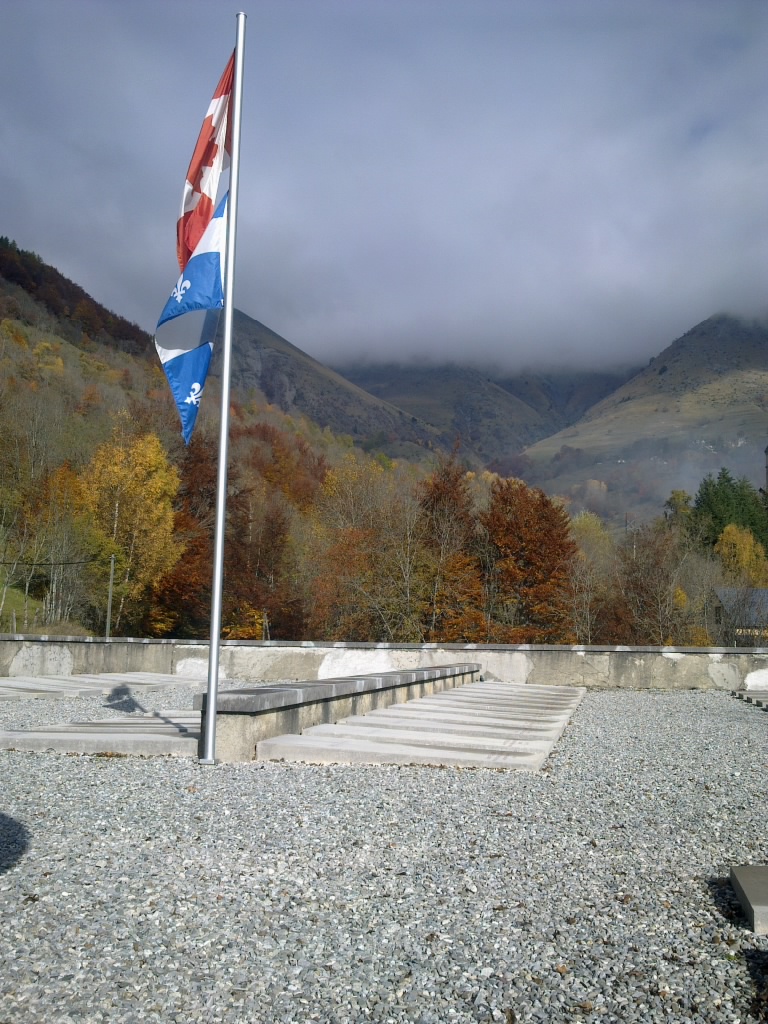
At the foot of the mountain, in the village of La Salette itself, there is a cemetery containing the graves of some Canadian pilgrims and aircrew. The Canadians were returning from a pilgrimage to Rome in November 1950 when their DC 4 aircraft crashed into a nearby mountain called L'Obiou (I think it might be the mountain hidden behind cloud in the second photograph above). Most of the pilgrims were older in years, and many were married couples. One can just see them having saved up for a once in a lifetime trip shortly after the end of the Second World War. The ages of the aircrew are noticeably younger.

The representation of the apparition at the entrance to the cemetery was made by students from a school in the Vosges region of France, using wreckage of the crashed aeroplane recovered from the mountain side. It was constructed to mark the 60th anniversary of the accident in 2010.


As you will see from my photographs, we were at La Salette at a most beautiful time for colours. I think we were able to see just about every possible colour of leaf as autumn seemed almost frozen at its most colourful.